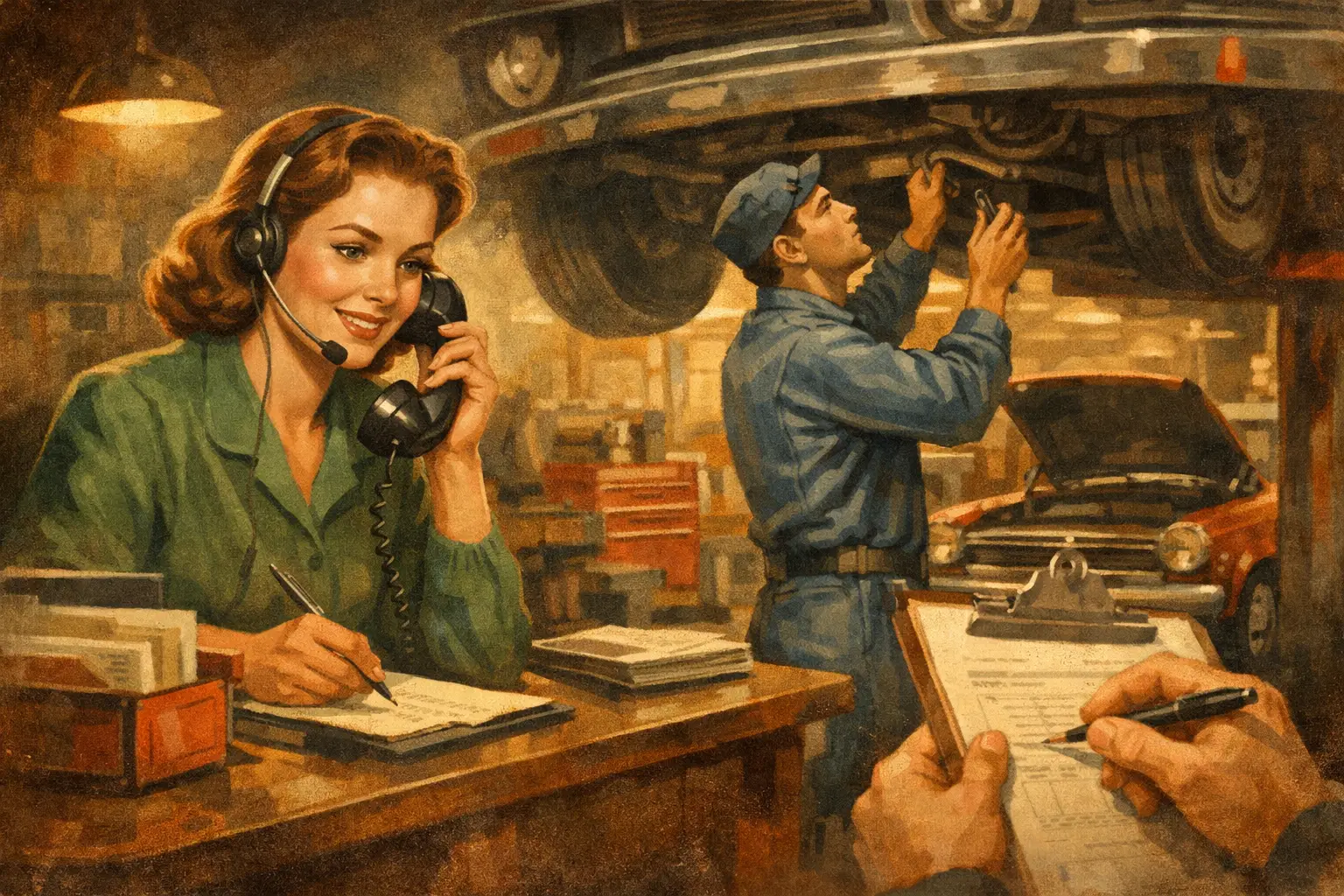
Auto Repair FAQ Answering Service: Why Generic Scripts Fail Shops
TL;DR: Most answering services claim they handle FAQs. The problem shows up on the calls they get wrong — the pricing question that boxes your tech into a bad appointment, the booking a caller shouldn’t have gotten, the complaint that got smoothed over instead of escalated. A useful FAQ answering service for a repair shop knows your shop’s rules. A generic one just answers.
—
Independent auto shops lose an average of $280 in booked revenue every time a qualified caller reaches voicemail during peak hours and doesn’t leave a message. That’s not an after-hours problem — it’s a front-desk problem. And the FAQ Friction Gap is where most of it happens: the distance between what a generic answering script covers and what your shop actually needs said on every call.
The phone rings while a tech has a car in the air, a service writer is chasing a parts number, and the owner is three fires deep. That call needs to go somewhere useful. If your FAQ answering setup can’t tell the difference between a routine oil change request and a caller your shop shouldn’t book, it’s not a front-desk solution — it’s a liability wearing a headset.
The FAQ Friction Gap: Where Generic Answering Services Break Down
Generic answering services hear a question and produce an answer. Auto repair shops need something different: a system that hears a question and knows what your shop would say.
“Do you work on BMWs?” might mean yes, no, or yes but only certain models and only by appointment. “Can I bring my own parts?” might mean no on most repairs, yes on batteries, or yes with no labor warranty attached. “How much for brakes?” might mean you give a range, you explain the inspection first, or you quote nothing until the vehicle is in the bay.
A generic script hears a routine FAQ. A shop-specific system hears a booking decision. The difference shows up in calendar quality, not call volume — bad-fit bookings, under-informed customers, and jobs that have to be re-explained at the counter because the phone setup didn’t tell the full story.
What an Auto Repair FAQ Answering Service Should Actually Know
Useful FAQ coverage starts with your service mix. Not a general description — the real operational detail. What you work on. What you don’t. Where your gray areas live.
Maybe you handle brakes, suspension, diagnostics, and maintenance, but not body work, transmission rebuilds, or customer-supplied performance parts. Maybe you service domestic and Asian vehicles but limit European work to certain makes. Maybe same-day oil changes are available before noon and cut off after that. These aren’t minor configuration settings — they’re the decisions your service writer makes thirty times a day, and your phone setup needs to make them too.
Then there’s booking logic. When the caller wants an appointment, what can the system offer, and for which service types? A serious FAQ answering service works from your actual calendar rules — lead time, service categories, diagnostic-first requirements, after-hours requests, and escalation triggers. Not wide-open guesses that fill the schedule with the wrong work. [LINK: increase-booked-appointments]
Tone is part of it too. Callers can hear when they’re talking to something stiff and generic. The right register is calm, direct, and knowledgeable about your operation — not a corporate help line, and not a system announcing itself as automated. [LINK: shop-specific-ai-phone-agent]
Does This Replace My Service Writer?
No — and it shouldn’t try to. The goal is targeted coverage where the pressure is highest, not a wholesale replacement of judgment.
When the phone handles routine FAQ volume reliably — hours, location, drop-off procedures, service availability, shuttle questions — your service writer stays on the work in front of them. When it can qualify common repair requests against your exclusions, your owner doesn’t get pulled into the shop floor to decide whether to take a specialty vehicle you’d normally screen out. When after-hours calls get captured instead of going to voicemail, your morning starts with actionable information instead of a message stack.
The calls that need judgment still get a human. A well-configured system knows when to escalate: the comeback complaint, the diagnostic dispute, the caller with a warranty question that needs a real conversation. That escalation should be intentional — not a fallback when the script runs out of answers. [LINK: after-hours-capture]
What to Ask Before You Choose One
Don’t evaluate an FAQ answering service on the demo call alone. Evaluate it on the calls it handles badly.
Can it explain your pricing policy without boxing your tech in? A caller asking for a brake quote should hear your actual approach — inspection-first, range, or diagnostic fee — not a number someone generated from a template.
Can it decline work cleanly? If your shop doesn’t install outside parts, doesn’t touch diesels, or doesn’t do body work, can the system communicate that without losing the caller or starting a dispute?
Does it route edge cases correctly? Upset callers, comeback situations, and warranty questions should reach a human fast. If the system tries to smooth those over with a canned answer, it’s creating downstream problems.
What does setup actually involve? “Plug-and-play” is a warning sign. A useful FAQ setup requires mapping your real service mix, your exclusions, your booking rules, and your escalation triggers before the first live call. Speed of setup and quality of setup are usually in tension.
A system that answers easy calls politely but mishandles the gray areas isn’t closing your FAQ Friction Gap. It’s generating a second front counter that has to be corrected after the fact.
The Standard: Every Call Should Sound Like Your Shop
The right FAQ answering service for an auto repair shop sounds like a capable front desk person who knows the operation — not a generic voice reading from a list of answers that could belong to any shop in any city.
That means your service exclusions are handled with confidence. Your pricing communication follows your rules. Your booking logic reflects how you actually run the calendar. And the calls that need real judgment get to a real person without making the customer feel like they hit a wall.
That’s the gap most generic services leave open. And it’s the one worth closing before it costs another qualified caller.
Hear what shop-specific FAQ handling sounds like on a real call. (615) 558-5787.
—
Our AI team goes to Napa. We install, test, and certify. Every part.
—
Thing to Remember: Generic FAQ answering services get easy calls right. We tackle what breaks on the hard ones — and what a shop-specific setup actually needs to know.
2 thoughts on “Auto Repair FAQ Answering Service That Works”