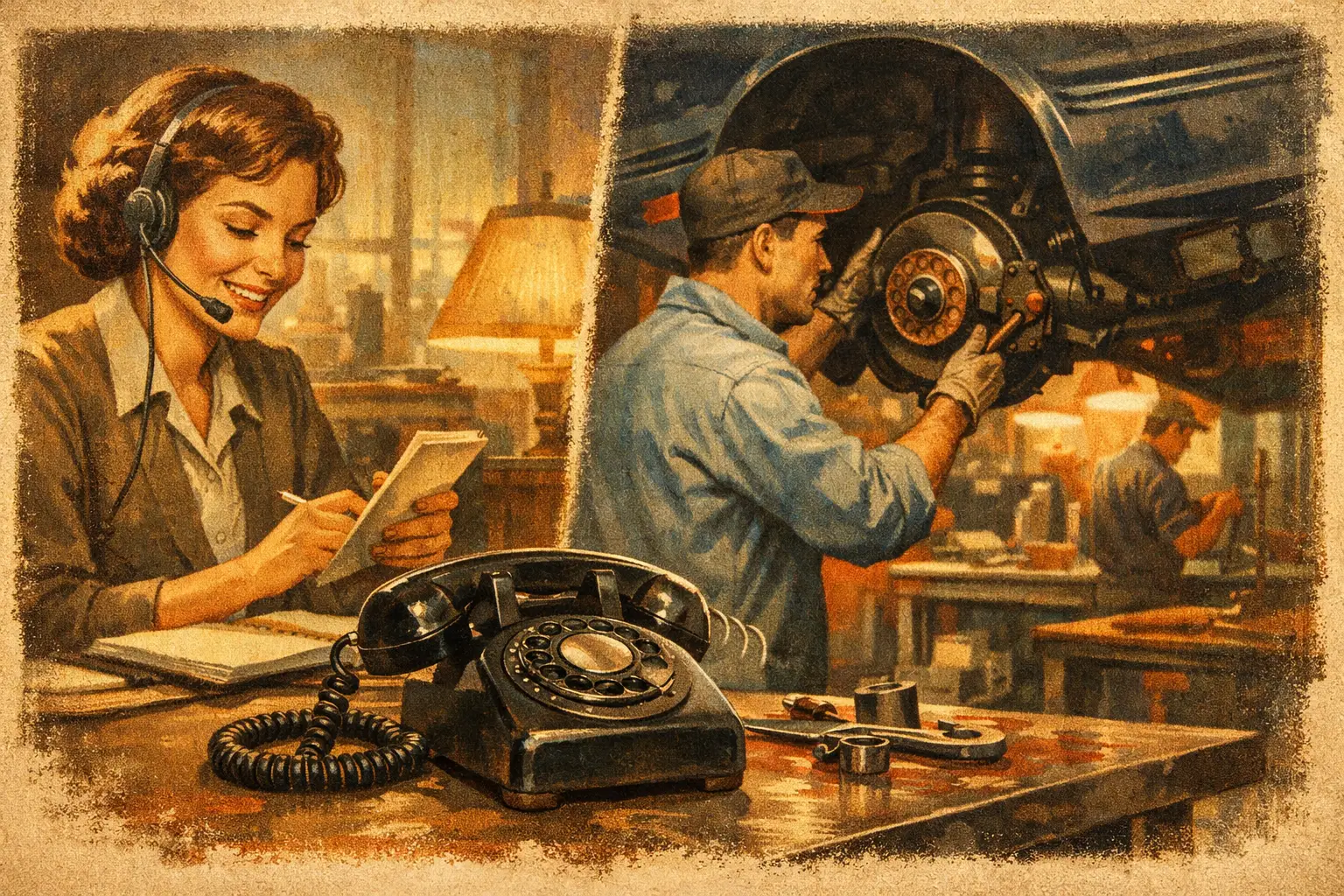
At 10:30 on a Tuesday, the phones start stacking up, a service writer is checking in two cars, and a tech needs an approval before lunch. That is where the virtual receptionist vs in house question gets real for an auto repair shop. It is not a theory problem. It is an operations problem that affects booked work, customer trust, and how many interruptions your team takes before noon.
For most independent shops, the right answer depends on call volume, how predictable the day is, and whether your front desk needs true counter coverage or just reliable phone coverage. Those are not the same job. A lot of owners lump them together, then wonder why the phone still feels like a fire drill.
Virtual receptionist vs in house: what are you actually comparing?
An in-house receptionist is a person on site handling phone calls along with whatever else lands at the front counter. They may greet walk-ins, take payments, relay updates, print repair orders, and help keep the lobby moving. In a busy shop, that person often becomes traffic control for the whole building.
A virtual receptionist handles inbound calls without being physically at the shop. The quality gap comes down to how specialized that setup is. A generic answering service might just take a message. A shop-specific virtual receptionist can screen pricing questions, capture after-hours leads, book qualified appointments, explain service exclusions, and hand off the right calls when a human needs to step in.
That distinction matters. If your comparison is between a trained front-desk employee and a generic call center, in-house usually wins. If your comparison is between a stretched-thin counter staffer and a purpose-built automotive phone system with booking rules, the math changes fast.
Where in-house still makes the most sense
If your front counter stays busy all day with walk-ins, payment collection, shuttle coordination, and face-to-face customer issues, an in-house employee may be the better fit. Some jobs need physical presence. A virtual receptionist cannot hand a customer keys, inspect a waiting room situation, or spot that someone at the counter is getting irritated.
In-house can also be stronger when your shop handles a lot of unusual work that changes by the hour. Maybe you fit custom parts, deal with older vehicles that need heavy triage before scheduling, or constantly make judgment calls about what you will and will not touch. In those cases, a strong front-desk employee who knows your shop cold can make the right call in real time.
There is also a culture factor. Some owners want one person at the desk who becomes the voice and face of the shop. That can work well if you find the right person, train them properly, and keep them long enough for the process to stick.
The catch is obvious: good front-desk people are hard to hire, expensive to replace, and easy to overload. If one person is answering phones, checking in customers, and chasing parts status, phone quality usually drops first.
Where a virtual receptionist pulls ahead
Phone coverage is where virtual usually wins. Not because it is flashy, but because it is consistent. Calls get answered during peak hours, after hours, and during the moments when everyone in the building is already tied up.
That matters more than many shops admit. Missed calls are not just missed conversations. They are missed inspections, missed brake jobs, missed second opinions, and missed customers who call the next shop on Google after the fourth ring.
A strong virtual receptionist setup also reduces interruption inside the shop. Instead of a tech getting dragged into a basic status question or a service writer stopping mid-write-up to answer, the call can be handled based on clear rules. If the caller wants to know whether you work on European vehicles, whether you install customer-supplied parts, or whether there is any same-day availability for an oil change, those answers can be delivered without pulling your team off the counter.
For smaller shops, this is usually the biggest advantage. You do not need a full-time body in the chair all day. You need the phone handled like someone competent is sitting there.
Cost is part of it, but overhead is the bigger issue
Most owners start with payroll math, but the better question is operational overhead. An in-house receptionist comes with wages, taxes, training time, coverage gaps, call-outs, turnover risk, and the constant need for supervision until the process is dialed in. That may still be worth it if the person is carrying real front-desk workload beyond phones.
A virtual receptionist becomes attractive when the phone burden is real, but the non-phone workload is not enough to justify another full-time hire. That is common in small to mid-sized shops where the service writer is already acting as receptionist by default.
There is also the hidden cost of inconsistency. If your team answers beautifully on Monday and lets calls roll to voicemail on Thursday because the shop is slammed, your customer experience is only as good as your busiest hour. That is not a stable system.
The real decision point: phone answering or front-desk coverage?
This is where shops make better decisions. Ask what problem you are actually trying to solve.
If the issue is missed calls, poor after-hours capture, too many interruptions, and weak appointment intake, you are solving for phone answering. A virtual receptionist is often the cleaner answer.
If the issue is lobby coverage, payment handling, in-person customer management, and constant desk traffic, you are solving for front-desk coverage. That usually points to in-house.
Some shops need both, but not at the same time. A common setup is using a virtual receptionist to handle overflow, after-hours calls, and routine booking while the in-house team focuses on customers already in the building. That keeps the counter from becoming a bottleneck.
Virtual receptionist vs in house for booking quality
Booking quality matters more than answer rate. Anyone can pick up a phone. The question is whether the call turns into the right appointment.
An in-house employee may have an edge if they deeply understand your schedule, technician strengths, and service mix. They can hear nuance and make judgment calls based on what happened in the shop that morning.
But that only works if they are trained and not rushed. In many shops, rushed staff take the path of least resistance. They overbook easy jobs, under-qualify diagnostic calls, and say yes to work the shop should have screened out. That fills the calendar but creates headaches later.
A well-configured virtual receptionist can be surprisingly strong here because the rules are fixed. It can ask whether the vehicle is driveable, whether the issue is diagnostic or routine maintenance, whether the customer is asking for a service you do not provide, and whether same-day booking should even be offered. Done right, that creates cleaner appointments and fewer bad-fit calls on your schedule.
For auto repair, that is the difference between productive car count and calendar clutter.
What can go wrong with each option
In-house fails when the wrong person gets hired, training is thin, or the role becomes a dumping ground for every admin task in the shop. Then phones get missed, messages get sloppy, and the customer experience depends on how chaotic the hour is.
Virtual fails when it is too generic. If it cannot speak your shop’s language, explain your booking windows, identify exclusions, or know when to escalate an upset caller, it will sound like a script. Customers hear that right away.
That is why setup matters more than the label. A bad in-house process is still bad. A bad virtual process is still bad. Shops should judge both by one standard: does this system answer calls the way we would want them handled on our best day?
How to choose without overthinking it
Look at your last two weeks of phone pain. Not your ideal workflow – your actual one. Count missed calls, after-hours calls, interruptions during write-ups, and how often someone in the shop had to stop what they were doing to answer something basic.
Then look at the front counter. Are people physically needed there all day, or is the desk mostly getting hammered by the phone? If you had perfect phone coverage tomorrow, would you still need another full-time person in the building?
If the answer is yes, hire for in-house front-desk strength. If the answer is no, solve the phone first.
For many independent repair shops, that is the cleaner path. A specialized virtual receptionist can take the repetitive inbound load off the team, tighten appointment intake, and stop after-hours opportunities from leaking away. That is especially true when the service is built around shop-specific call logic instead of generic answering. Ratchet Call was built for exactly that kind of workflow in auto repair shops.
The best choice is the one that protects technician focus, keeps the calendar honest, and makes callers feel like they reached a shop that has its act together. Shops can hear it firsthand by calling the live demo line: (615) 558-5787.

1 thought on “Virtual Receptionist vs In House for Shops”