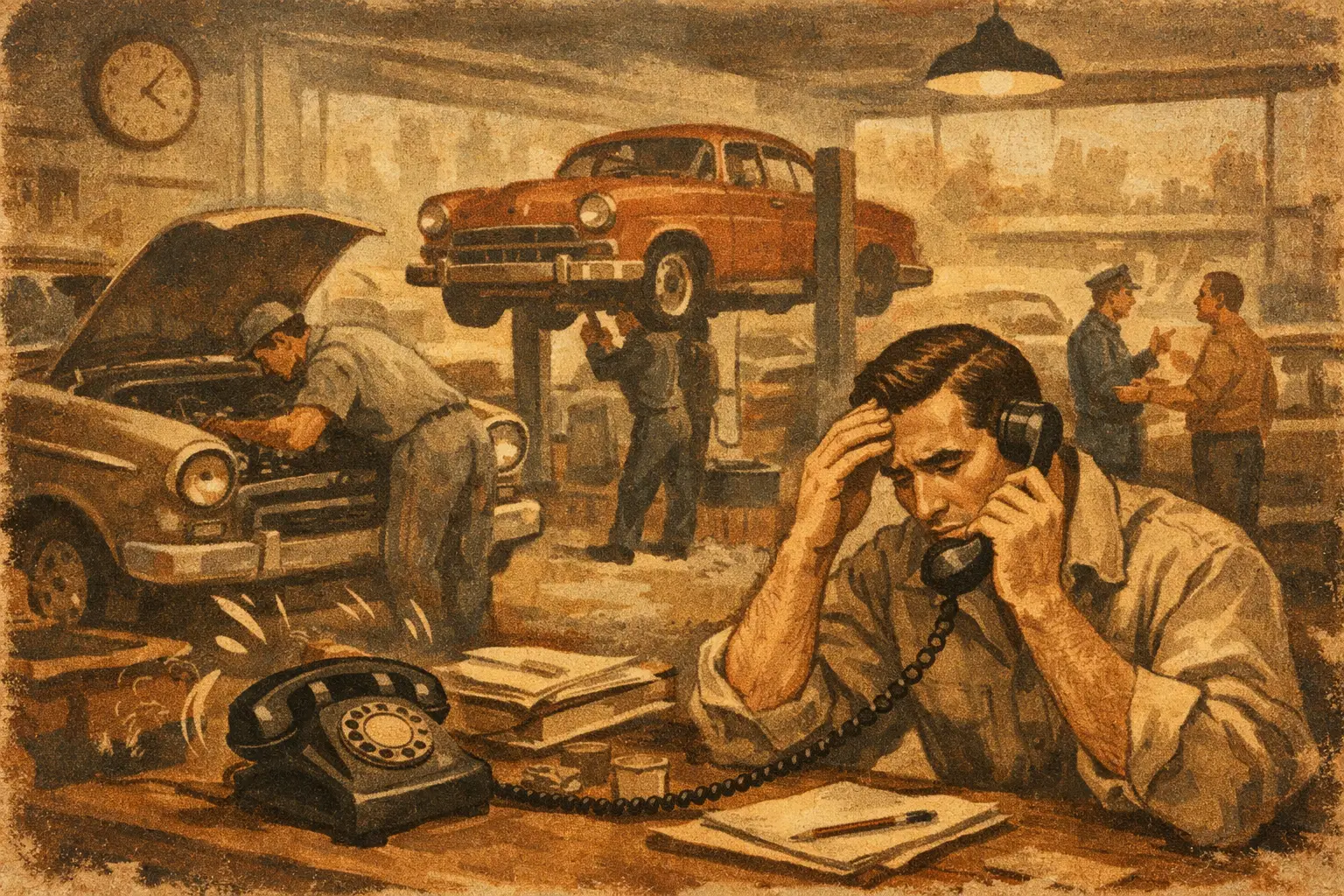
A customer calls at 10:17 a.m. while the service writer is explaining a failed water pump, a tech needs approval on a parts order, and somebody is standing at the counter asking when their brakes will be done. The phone rings four times, then goes to voicemail. That caller was not looking for a conversation. They were looking for a shop that could get them in.
That is why shops miss calls: not because the team does not care, but because a working repair shop creates too many real-time demands for one person to cover perfectly. The problem gets worse during the exact hours when the phone is most valuable. A missed call at 8:00 a.m. may be a tow-in. A missed call at noon may be a customer comparing estimates. A missed call at 4:30 p.m. may be tomorrow morning’s first appointment.
Why Shops Miss Calls When the Bays Are Full
Most independent shops do not have a phone problem. They have a coverage problem.
The person expected to answer is usually doing three jobs at once. They are writing up a vehicle, checking the schedule, calling for parts, getting authorization, moving a waiting customer through payment, and trying to keep technicians from standing around. When the line rings in the middle of that, the caller is competing with work already in motion.
Even shops with a dedicated service writer run into this. A service writer can answer quickly for an hour, then get trapped in a complicated diagnosis conversation or an upset customer situation. One long call can stack up multiple missed calls behind it. The front desk does not need to be careless for this to happen. It just needs to be busy.
There is also a hard trade-off that owners know well: every interruption has a cost. If the owner or a technician drops a job to answer a basic question about an oil change, inspection, or tire repair, the work in the bay slows down. If nobody answers, the shop risks losing a new customer. Shops often bounce between these two bad options because the phone is treated as an interruption instead of a workflow.
The caller’s expectation has changed
Customers do not usually leave a detailed voicemail and wait patiently for a return call. They call two or three shops. The first one that sounds organized, understands the request, and offers a clear next step often gets the job.
That does not mean every call should turn into an appointment. A good front desk knows the difference between a legitimate booking opportunity and a request the shop should not take. Maybe the shop does not perform body work, rebuild transmissions, work on certain European makes, or have room for same-day drop-offs. The point is not to say yes to everything. The point is to answer every caller with useful, shop-specific judgment.
The Hidden Places Call Coverage Breaks Down
The obvious missed call is easy to spot in the call log. The more expensive failures are quieter.
After-hours calls are one example. A driver hears a noise on the way home, gets a warning light, or realizes their vehicle will not start the next morning. They call at 6:40 p.m. If the voicemail only says to call back during business hours, the shop has given that customer no reason not to keep searching.
Lunch coverage creates another gap. Shops may rotate the front desk, but whoever steps in may not know the schedule, service exclusions, vehicle history, or how to handle a caller asking for a price. They take a name and number, promise a callback, and the note gets buried under invoices and repair orders.
Then there are the calls that technically get answered but still go nowhere. A rushed employee may say, “We are booked up,” when the shop actually has a diagnostic slot later in the week. They may quote a price without knowing the vehicle details, or tell a caller to call back because the service writer is unavailable. From the customer’s side, that feels nearly the same as a missed call.
Price shoppers deserve special attention. They are not all the same. Someone asking, “How much for brakes?” may be collecting numbers. Or they may be trying to understand whether a grinding noise needs immediate attention. A trained call process gathers the right details: year, make, model, symptoms, whether the vehicle is safe to drive, and whether the caller needs an inspection or a quote. It gives the caller a next step without making up a number or tying up a service writer for ten minutes.
Why More Staff Is Not Always the Fix
Hiring a full-time receptionist can make sense for a high-volume shop with enough steady call traffic and counter activity. But it is not a magic answer.
A new receptionist still needs to learn what the shop does and does not do, which technicians handle which work, how far out the schedule is, what counts as an emergency, and when to hand off a live call. Without that knowledge, the person answering the phone becomes a message taker. The shop pays for coverage but still has to chase down missed opportunities later.
For smaller shops, the math can be tougher. Call volume is uneven. Mondays may be slammed, while Wednesday afternoon is quiet. The shop needs reliable coverage at the pressure points, not necessarily another full-time person sitting at the desk all day. It depends on volume, staffing, and how much booking authority the shop is willing to delegate.
The better question is not, “Do we need someone to answer the phone?” It is, “What should happen on each type of call when our team is tied up?”
Build a Phone Process That Works Like a Service Writer
A usable phone process starts with decisions, not technology. Before adding any call coverage, map the situations that show up repeatedly.
Define which services can be booked directly, which need a callback, and which should be declined. Set rules for same-day appointments, drop-offs, inspections, fleet work, warranty questions, and vehicles that may need towing. Decide what information must be collected before an appointment is placed on the calendar.
Then establish the handoff rules. An upset customer with an active repair order may need a live transfer to the service writer. A new customer asking about a check-engine light may only need a diagnostic appointment and basic arrival instructions. A caller requesting collision repair should be politely redirected if that is outside the shop’s lane. Good call handling is not one script. It is a decision tree built around how the shop actually operates.
Calendar rules matter just as much. If callers can book an appointment, the system needs to know the difference between an oil service opening and a diagnostic opening. It needs to avoid packing the schedule with work the team cannot complete, and it must honor the time blocks the shop reserves for inspections, fleet accounts, or already-promised jobs. A full calendar is not useful if it is full of bad appointments.
Finally, review the early calls. Listen for callers who ask questions the process did not anticipate. Look for missed handoffs, unclear answers, and appointments that should have been routed differently. The first version does not have to be perfect. It does have to improve from real shop conversations.
What Reliable Coverage Looks Like in Practice
Reliable coverage does not mean a robot blindly booking every caller. It means the customer reaches a professional voice that knows the shop’s name, services, booking boundaries, and escalation path.
For an independent repair shop, that might mean an after-hours caller can request a diagnostic appointment, a morning caller can get scheduled without waiting for the counter line to clear, and a current customer with a problem can be handed to the right person. It means a technician stays on the vehicle while the front desk stays in control of the conversation.
That is the standard Ratchet Call is built around. The call flow is customized before it goes live: service knowledge, exclusions, appointment windows, pricing inquiry handling, after-hours capture, and live staff handoffs. The goal is not generic answering. It is front-desk coverage that behaves like it belongs in your shop.
A shop will always have busy moments. Cars will arrive without appointments. Parts will be late. Customers will need answers at the counter while another customer is calling about a no-start. You cannot remove that pressure. You can decide whether the phone becomes one more fire to put out or a dependable path to the next good job.
Shops can hear it firsthand by calling the live demo line: (615) 558-5787.