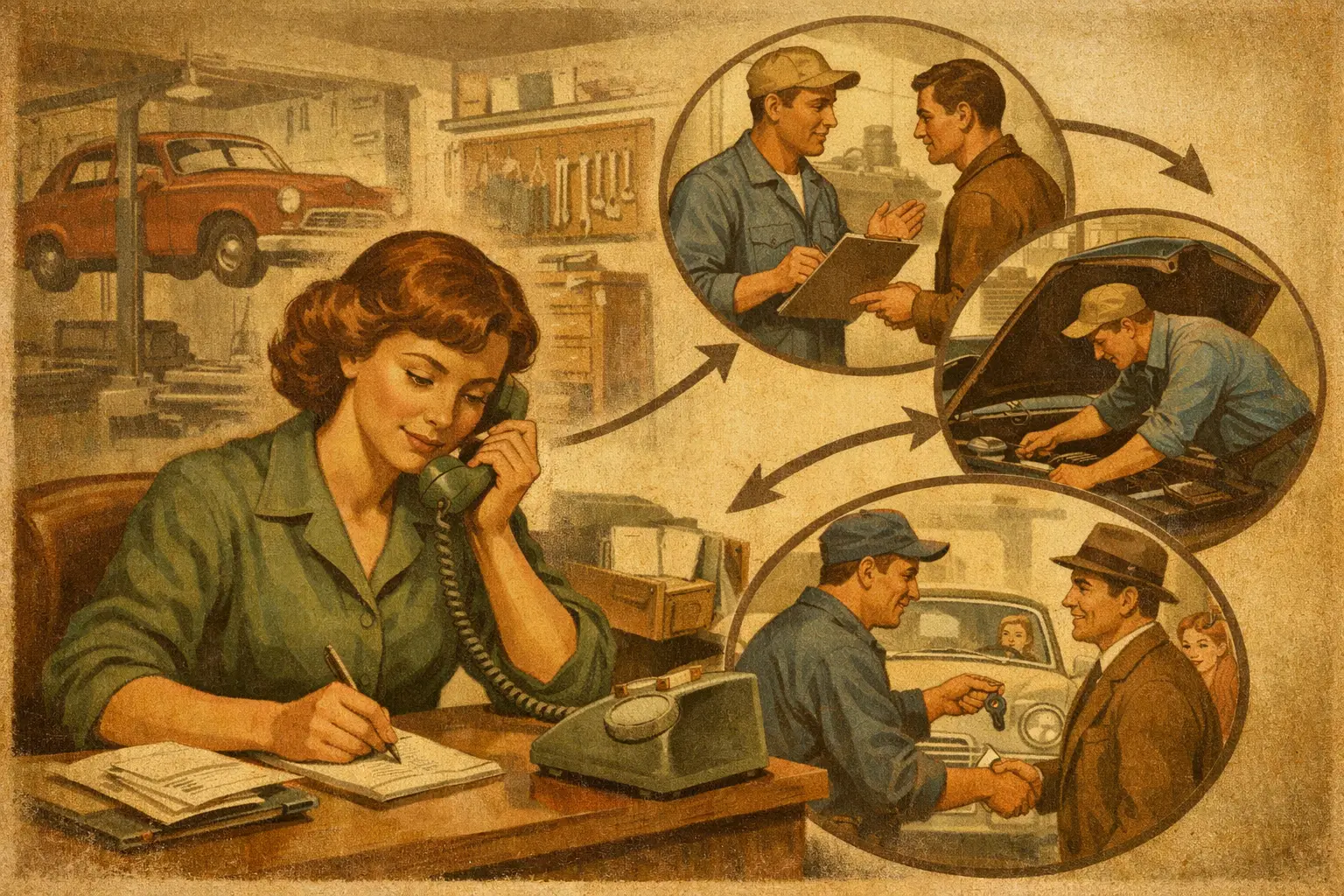
A ringing phone is not background noise in a repair shop. It is a customer deciding whether to book with you, call the next shop, or put off the repair another week. Good example call flows for repair shops make sure that call gets handled like it reached an experienced service writer – even when your team is buried in inspections, approvals, and vehicles on lifts.
The goal is not to force every caller through a stiff script. The goal is to give whoever answers clear judgment: what to ask, what can be booked, what needs a callback, and when to get a real person involved. That is how the front desk stays helpful without promising work your shop cannot or will not do.
What a Repair Shop Call Flow Should Do
A call flow is the decision path behind a conversation. It keeps the first few minutes organized so the caller feels heard and your team gets the information needed to take the next step.
For most independent shops, a useful flow has five jobs: identify the caller and vehicle, understand the reason for the call, confirm the service fits the shop, offer the right appointment or next action, and document anything the service writer needs to know.
The order matters. Booking a “brake job” before asking whether the customer has a soft pedal, a warning light, or metal-on-metal noise can create a bad handoff. On the other hand, turning every simple oil-change request into a long interview slows down the phone and frustrates customers.
Your rules should match how your shop actually runs. If you do not install customer-supplied parts, say so early. If diagnostic appointments require a drop-off, make that clear before offering a time. If same-day work is reserved for existing customers or straightforward services, build that into the flow instead of leaving it to guesswork.
Example Call Flows for Repair Shops
1. The routine maintenance call
This is the easy one, but it still needs guardrails.
Caller: “How much is an oil change?”
Front desk flow: Start with the vehicle year, make, model, and engine when needed. Then confirm whether the caller wants a conventional or synthetic oil service, ask about mileage if it affects the recommendation, and check the calendar for the correct service window.
A solid response sounds like this: “I can help with that. What year, make, and model are you driving? I’ll make sure we quote the right service and see what openings we have.”
If your shop gives starting prices over the phone, the flow can provide that range with a clear condition: final pricing depends on the vehicle and oil capacity. If your policy is to quote only after vehicle details are confirmed, do not let the call handler make up a number just to satisfy the caller.
The booking should capture the service requested, vehicle information, preferred day and time, and a callback number. For a routine appointment, that is usually enough.
2. The warning light or drivability call
A check engine light is not an appointment type by itself. It is a symptom, and the flow needs to separate a normal diagnostic request from a possible safety issue.
Caller: “My check engine light came on and the car is shaking.”
Front desk flow: Ask whether the check engine light is flashing or solid. Ask whether the vehicle is safe to drive, whether it is losing power, overheating, smoking, or making a severe noise. These questions are not a diagnosis. They are a triage screen.
If the caller reports a flashing check engine light, active overheating, smoke, or a vehicle that barely runs, the right next step may be to advise against driving it and discuss a tow or immediate staff handoff. Do not promise a same-day repair before the vehicle is inspected.
For a solid light with no urgent symptoms, the call can move to a diagnostic appointment: “We’ll need to inspect it before we can tell you what is causing the light. I can get you scheduled for diagnostic testing. Will you be dropping it off, or are you waiting?”
That final question matters. A shop that books a waiting customer into a drop-off-only diagnostic slot creates a problem before the customer arrives.
3. The brake, steering, or safety concern
Safety calls deserve a shorter path to a real person when symptoms are serious.
Caller: “My brakes are grinding. Can you get me in this afternoon?”
Front desk flow: Confirm the vehicle, then ask only what is needed to understand urgency: Is the brake pedal soft? Is there a brake warning light? Is the vehicle pulling hard, vibrating severely, or leaking fluid? Can the caller drive it safely to the shop?
If the customer says the pedal goes to the floor or the vehicle will not stop normally, do not treat that as an ordinary booking request. Escalate it. If the issue is grinding but the vehicle remains controllable, the call can offer the earliest inspection opening while avoiding a repair promise.
The language should be plain: “Grinding can mean the brakes need attention quickly. We can inspect it and let you know what it needs. Based on what you described, if braking feels unsafe, please do not drive it.”
This is one place where a polished script can do damage. The flow must leave room for judgment.
4. The price shopper
Price calls are normal. What hurts shops is spending five minutes quoting repairs that cannot be accurately quoted without seeing the vehicle.
Caller: “What do you charge to replace an alternator on a Honda?”
Front desk flow: Gather year, model, engine, and the reason the caller believes it needs an alternator. If another shop diagnosed it, ask whether they have a written estimate or diagnostic findings. If the customer is guessing based on a dead battery, explain that testing is needed before quoting the repair.
A useful answer is: “We can absolutely take a look. Alternator pricing varies by engine and by what testing shows. If the battery is just weak, the repair could be different. Let’s get the vehicle information and set up a test so you are not buying parts you do not need.”
That approach does not dodge the question. It protects the shop and the customer from a bad quote. If your shop has firm menu pricing for common services, the flow can provide it. If it does not, it should move the caller toward diagnosis instead of false precision.
5. The service your shop does not perform
The cleanest call flows include exclusions. Saying no clearly is better than accepting a job that does not fit your bays, equipment, or technicians.
Caller: “Do you rebuild transmissions?”
Front desk flow: Confirm the request, state the shop’s policy, and offer the appropriate alternative only if you truly provide one. For example: “We do transmission diagnostics and certain related repairs, but we do not perform complete transmission rebuilds.” If you refer that work out, say so without making promises on another business’s behalf.
Common exclusions may include body work, tires, heavy diesel work, certain European makes, custom performance work, customer-supplied parts, or internal engine and transmission rebuilds. Every shop is different. The important part is putting those rules in the call flow before calls go live.
A vague “bring it in and we’ll see” may fill the calendar, but it also creates avoidable friction at the counter.
6. The after-hours caller
After-hours calls are often high-intent calls. The customer has a problem, their vehicle is down, and they are trying to make a plan before the next workday.
Caller: “My car won’t start. Are you open tomorrow?”
Front desk flow: Capture the caller’s name, phone number, vehicle details, general concern, and preferred contact time. Confirm the next available booking option if your calendar rules allow it. If the shop needs to review the issue before scheduling, set that expectation: “We’ll have the service team review your request when we open and call you back to confirm the best next step.”
Never create a false sense that someone is actively diagnosing the vehicle after hours. The win is not pretending the shop is open. The win is making sure the lead is captured, organized, and ready for follow-up instead of landing in voicemail.
Build Handoffs Around Real Shop Decisions
Not every call should end with an appointment. Some should go directly to a service writer or manager. Examples include an upset customer asking about an existing repair, a fleet account with an urgent vehicle, a customer disputing a charge, a tow truck arriving, or a question about a vehicle already in your shop.
Define who gets those calls, when they are available, and what happens if they cannot pick up. A live handoff is useful only when it actually reaches somebody. Otherwise, take a clean message with the vehicle, repair order details if available, and a specific callback reason.
Ratchet Call maps these decisions before launch, then reviews early live calls to tighten the wording, booking rules, and escalation points. That matters because the best phone handling is not generic. It is built around your bays, your service mix, and the promises your team can keep.
Start With the Calls That Cost You the Most
Do not try to map every possible phone conversation in one sitting. Start with the calls that interrupt your crew most often or turn into lost opportunities: maintenance pricing, check engine lights, no-starts, brake concerns, status requests, and after-hours messages.
Listen for where callers get stuck and where your team gives inconsistent answers. Those are the spots that need a rule, a better question, or a handoff path. A good call flow should feel natural to the customer and boringly reliable to the shop.
Shops can hear it firsthand by calling the live demo line: (615) 558-5787.