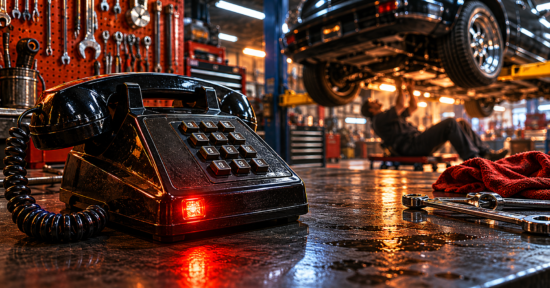
The phone rings. You’re elbow-deep in a valve cover gasket. Your service writer is at the counter with a customer. The tech in bay three just asked about a part number.
Nobody picks up.
That caller needed an oil change, maybe a brake job. They waited four rings, got voicemail, and called the next shop on Google Maps. That was a $300 ticket. Maybe a $900 ticket. Gone in under ten seconds.
Most shop owners know this happens. Very few have ever stopped to add it up.
What One Missed Call Actually Costs
The average repair order at an independent shop runs between $280 and $450. Specialty work — transmissions, timing chains, suspension — runs $800 to $1,500 or more.
Call it conservative: $350 average ticket.
Now ask yourself: how many calls does your shop miss in a day?
Industry research puts the missed-call rate for independent auto repair shops between 35% and 62% of all inbound calls during active shop hours. That’s not calls at 2am. That’s calls while you’re open — during lunch, during the morning rush, during a busy Saturday.
At a modest 5 missed calls per day, 250 working days a year, $350 per ticket:
That’s $437,500 in potential revenue walking out the door annually.
Even if only half those callers would have booked — that’s $218,000. Even if your conversion rate on answered calls is 60% — you’re still looking at losses that dwarf the cost of any receptionist you could hire.
And yet the receptionist is where most shop owners focus.
The Real Problem With Hiring a Receptionist
A full-time service writer or dedicated front-desk hire costs between $36,000 and $48,000 per year in salary alone. Add payroll taxes, benefits, turnover, training — you’re realistically at $42,000 to $55,000 annually for one person answering phones.
That sounds like a lot. But here’s what that hire actually gives you:
Coverage from roughly 8am to 5pm, Monday through Friday — minus lunch.
They call out sick. They quit. They handle one call at a time. When a customer is standing at the counter, the phone goes to voicemail. When two calls come in at once, one goes to voicemail. After hours, nights, weekends, holidays — voicemail.
A 2023 analysis of automotive service callbacks found that voicemail return calls convert at less than 20%. Meaning 8 out of 10 customers who leave a voicemail never book.
Your $42,000/year hire is working hard, taking on too much, and still leaving a gap wide enough to drive a truck through.
This isn’t a criticism of the person. It’s a structural problem. One human being cannot cover every inbound call, every hour, without limit. The shop’s phone demand is not shaped around their schedule.
Where the Calls Actually Disappear
The missed-call problem in auto shops isn’t random. It clusters.
Lunch (11am–1pm). The service writer is eating, covering the counter, or handling a pickup. Call volume doesn’t stop. Appointments don’t pause. Phones go to voicemail.
Morning rush (7:30am–9am). First appointments are arriving. Techs are getting assigned. The front desk is a traffic jam. Inbound calls stack up with nobody available to answer.
After hours (5pm–8am and weekends). This is when people decide they have a car problem. They’re done with work, they’re thinking about their vehicle, they pick up the phone. If nobody answers, they move on. They don’t call back in the morning.
When it gets busy. The irony of auto repair is that your phone volume peaks exactly when your team is most overwhelmed. A good week — every bay full, walk-ins coming in — is exactly when calls get dropped. You’re losing revenue on your best days.
The Number No One Talks About: After-Hours Leads
If your shop closes at 5:30pm, you have zero inbound coverage for the next 14 to 16 hours. In that window, people call to book an appointment for tomorrow, ask about a warning light, or decide whether to bring their car in at all.
Without live coverage, those calls go to voicemail. Most won’t leave a message. Of the ones who do, the majority won’t answer when you call back, or they’ve already found another shop.
A shop running three bays with average ticket values can lose 2–4 bookable jobs per week from after-hours calls alone. At $350 average — that’s $700 to $1,400 per week. Over a year, $36,000 to $72,000 in revenue that never showed up on your calendar.
No line item for it. No column in your report. Just jobs that never happened.
What Shops Do Instead — And Why It Doesn’t Work
Most independent shops try to solve this with one of three approaches:
Hire someone. Costs $40K+/year, still misses calls during lunch and after hours, turns over every 12–18 months, needs training, calls out sick.
Let voicemail handle it. Sub-20% callback conversion. Most callers don’t leave messages. The ones who do often book elsewhere before you return the call.
Have the tech or owner answer. This pulls a $75–$100/hour technician off a car to answer a call that a receptionist should handle. Every minute on the phone is a minute not billing. And the call still might not get answered — because the tech is under a car.
None of these approaches covers your actual call volume. They handle some calls, some of the time, at high cost and low reliability.
The Math, Flat Out
| Scenario | Annual Cost |
|---|---|
| Full-time receptionist (salary + overhead) | $42,000–$55,000 |
| Missed calls with receptionist (nights, weekends, lunch) | $36,000–$218,000+ |
| Voicemail callback conversion loss | Additional 80% of voicemails never book |
| Total annual revenue exposure | $80,000–$270,000+ |
The receptionist is not the problem. The gaps are the problem. And the gaps exist because the phone doesn’t follow business hours.
What Changes When Every Call Gets Answered
When a caller gets a live answer — whether human or otherwise — booking rates jump. Callers who reach a live voice convert at 4x the rate of callers who leave a voicemail.
That’s not a technology claim. That’s a basic sales principle: a live conversation closes. A voicemail doesn’t.
A shop running RatchetCall answers every inbound call, 24 hours a day, under their shop name. Appointments book directly to the calendar. After-hours calls get captured and queued. The caller gets what they called for — a real answer and a real booking.
The service writer still handles the counter. The tech stays on the car. The owner stays out of the phone queue.
The missed call problem doesn’t get patched. It gets eliminated.
Hear What Your Customers Would Hear
Call (615) 619-8044 right now. That’s a live RatchetCall agent configured as Grease Monkey Automotive in Murfreesboro. Book an appointment. Ask about hours. Ask what a brake job costs.
Then ask yourself what it would mean if every call to your shop sounded like that — at 7am, at 9pm, on Saturday morning when your service writer is off.
Ready to stop losing jobs you never knew you missed? Start at RatchetCall.com.
6 thoughts on “The True Cost of a Missed Call in Your Auto Shop”
Comments are closed.